


News Stories
Why semi-dried noodles matter in technical evaluation
People searching for how semi-dried noodles are made are usually not looking for a textbook definition. They are trying to judge whether this category is technically stable enough for their own use case: central kitchen supply, retail shelf distribution, OEM development, or industrial staple-food planning. The real question is not whether semi-dried noodles exist, but what makes them different from fresh noodles and fully dried noodles in terms of process control, safety margin, texture retention, and shelf life.
Semi-dried noodles sit between two manufacturing logics. They are not wet enough to behave like fresh noodles, and not dry enough to follow the same assumptions as shelf-stable dried noodles. That middle position is exactly why they are interesting to technical evaluators: the product can preserve a fresher eating quality while still reducing cold-chain pressure, but only if the moisture profile, thermal treatment, and packaging design are tightly matched.
The core process is simple. The control points are not.
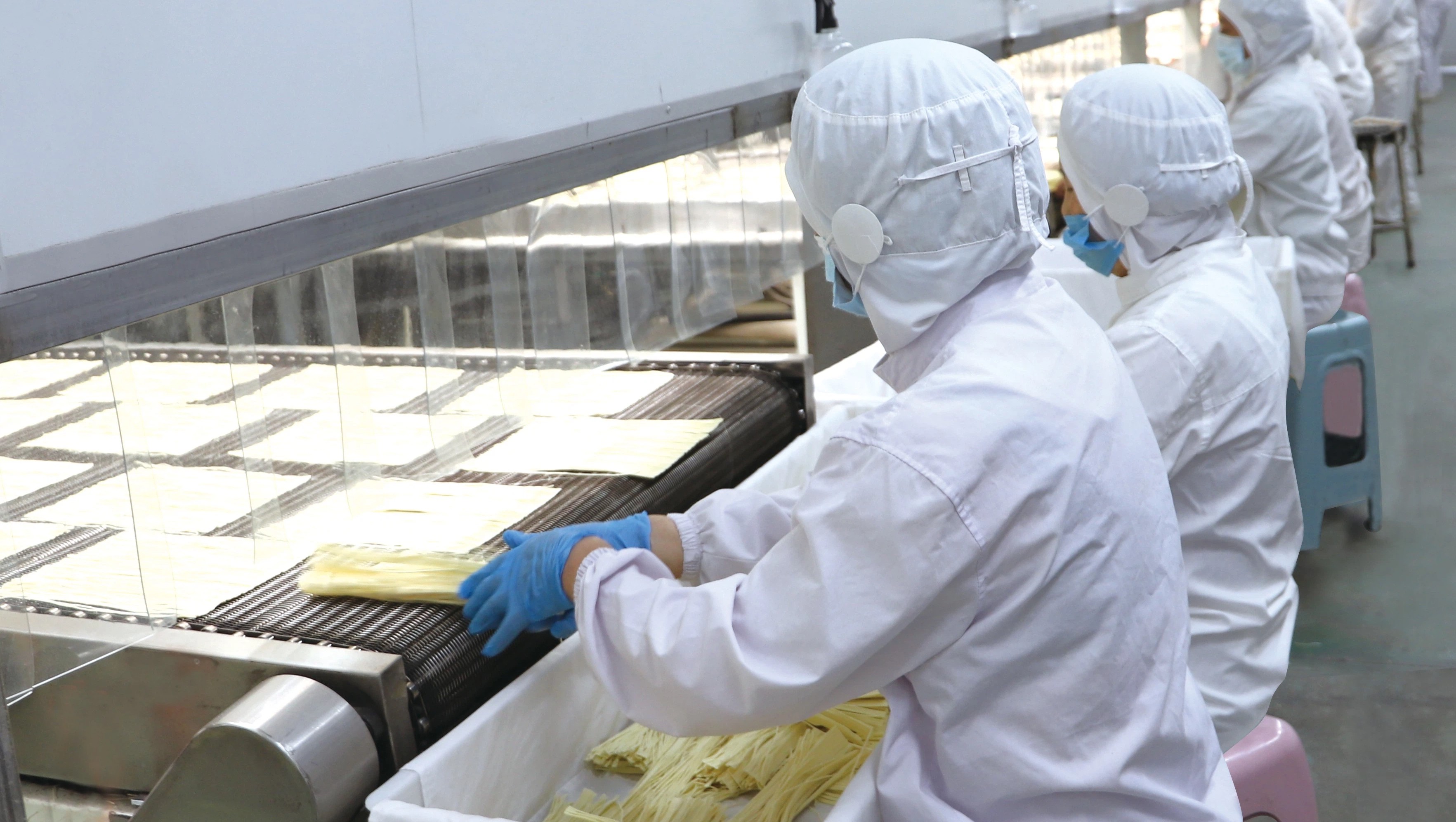
At a high level, semi-dried noodle production usually follows six steps: raw material selection, dough mixing, sheeting and forming, partial drying or stabilization, cooling and equilibration, then packing. The sequence sounds ordinary. The technical difference lies in how narrow the acceptable operating window is at each step.
For a stable product, the flour system must support gluten development without producing a dough that is too soft or too elastic to handle. Water addition, mixing energy, resting time, and sheeting reduction all influence the final structure. If the dough network is weak, the noodle strand will not survive partial dehydration well. If it is too tight, the finished noodle may become brittle, resistant to rehydration, or uneven in bite.
Forming also matters more than many non-specialists assume. Width, thickness, strand uniformity, and surface smoothness all affect drying behavior. Uneven strand geometry leads to moisture gradients: the outer layer dries faster than the core, which increases the risk of case hardening, internal staling, or a cooked texture that is either gummy at the center or rough at the surface.
Moisture control is the defining variable
In semi-dried noodle production, moisture is not just a quality indicator. It is the central design variable that determines texture, microbial risk, and distribution scope. The exact target moisture level varies by formulation and regulatory context, and should be verified against the applicable product standard or enterprise specification【待核实】. What matters operationally is that moisture must be reduced enough to slow spoilage, but not so aggressively that the product loses the elastic, near-fresh eating quality that defines the category.
This creates a narrow process balance:
- Too much residual moisture: shelf life shrinks, microbiological risk rises, and packaging becomes more demanding.
- Too little residual moisture: the noodle loses its intended soft-chewy texture and may behave more like a conventional dried product.
- Uneven moisture distribution: the product may pass lab inspection but still fail in cooking consistency or storage stability.
For technical teams, the practical question is not only the final moisture number, but also how that moisture is distributed through the strand. Internal gradients are what drive real-world failures. A batch can look acceptable on paper and still produce inconsistent cooking because the outer layer and core do not respond the same way to heat and hydration.
That is why stabilization after drying is often underestimated. Once the noodle leaves the hot-air or low-temperature drying stage, it needs time to equalize. Without sufficient cooling and moisture migration control, the product can shift during packaging or early storage, changing texture after it has already been released.
Drying method shapes the whole product profile
Not all semi-dried noodles are made with the same drying logic. Some lines emphasize low-temperature air drying, some use staged dehydration, and some combine surface fixation with controlled internal moisture removal. The choice affects not only throughput but also the finished product’s resilience.
Low-temperature or staged drying is often preferred when the goal is to preserve noodle elasticity and reduce thermal damage. That said, lower temperatures usually demand longer residence time and stricter airflow management. Faster drying can improve line efficiency, but if the rate is too aggressive, it may lock in a dry shell while leaving the center too wet. The result is a product that is difficult to store and unpredictable in cooking.
For buyers and technical evaluators, the key is to ask how the line controls the drying gradient. Useful indicators include airflow uniformity, belt loading density, residence-time consistency, and the existence of in-line moisture monitoring. These are more meaningful than a generic claim of “advanced drying technology.”
Texture is a process outcome, not a marketing claim
Semi-dried noodles are often positioned as offering a fresher bite than dried noodles and more convenience than fresh noodles. That is directionally true, but only if the process preserves the gluten network and avoids excessive surface hardening. Texture comes from a combination of flour quality, mixing discipline, sheeting precision, and moisture profile.
From an evaluation standpoint, a good batch should show three properties after cooking: reasonable tensile integrity, smooth surface behavior, and a bite that does not collapse into mush or become rubbery after a short hold. If a product requires excessive recipe compensation at the cooking stage, the manufacturing process may be too unstable for high-repeat commercial use.
In practice, technical teams should test not only the first cook, but also delayed cook and over-hold conditions. Products intended for retail or foodservice often face uneven real-world handling. A semi-dried noodle that performs well only under ideal lab timing is less useful than one that remains acceptable after modest process variation.
Food safety and shelf life depend on more than dryness
Lower moisture improves storage stability, but semi-dried noodles are not automatically shelf-stable in the same way as fully dried products. Shelf life depends on the combined effect of moisture, water activity, packaging barrier, hygiene during manufacturing, and storage temperature. A weak point in any one of these can shorten practical life substantially.
Packaging is especially important. Semi-dried noodles typically need a barrier system that limits moisture gain and prevents odor transfer. If the package film or seal quality is weak, the product may absorb humidity during transport and lose its intended texture long before the printed shelf life ends. This is a common gap between nominal shelf life and commercial shelf performance.
For buyers, this means shelf life should not be treated as a single number on a label. It should be evaluated against distribution conditions: ambient warehouse storage, seasonal humidity, transport duration, and whether the product will face retail open-shelf display or controlled inventory. A product that is technically sound in winter logistics may behave very differently in humid summer turnover.
What technical evaluators should ask suppliers
When reviewing a semi-dried noodle supplier, the most useful questions are process questions, not branding questions. A serious manufacturer should be able to explain how it controls moisture, texture, and microbiological stability at each stage.
- What is the target moisture range, and how is it measured in production?
- How is strand thickness controlled across the line?
- What drying profile is used, and how is residence time validated?
- How is post-drying equilibration handled before packing?
- What packaging barrier is used, and what storage condition is assumed for shelf-life claims?
- Which internal standards or external standards apply to the product specification【待核实】?
These questions matter because semi-dried noodles can be scaled in very different ways. A producer with strong process discipline may build a reliable national distribution product. A producer with weaker control may still ship a sample that tastes good in trial cooking but fails under mass logistics.
Commercial fit depends on the channel
From a business perspective, the category is most attractive where a buyer wants a compromise between freshness and reach. Retail chains, regional distributors, foodservice brands, and staple-food programs all see value in that middle position, but only if the product profile matches the channel.
For retail, the product must hold texture through ambient display and customer storage after purchase. For foodservice, consistency and cooking tolerance matter more than premium mouthfeel alone. For B2B ingredient or OEM programs, the relevant issue is whether the noodle can be integrated into a stable SKU family without requiring specialized handling.
This is also where supplier capability becomes relevant. A manufacturer with broad line capacity, multiple product brands, and experience in low-GI or health-oriented staple foods may have stronger formulation and quality-control infrastructure than a small-scale producer, but scale alone is not proof of technical fit. The real test is whether the company can demonstrate batch consistency, shelf-life validation, and traceable process control under the relevant channel conditions.
Common assumptions that do not fully hold
There are several claims around semi-dried noodles that sound reasonable but are incomplete in practice.
First, “semi-dried” does not automatically mean “healthier” or “cleaner-label.” Nutritional positioning depends on the flour system, additives, fiber content, and any low-GI or enrichment formulation. Moisture level is a processing attribute, not a nutrition claim.
Second, longer shelf life does not automatically mean easier distribution. If the moisture barrier, sealing quality, or storage assumptions are weak, the product may still degrade quickly in real logistics.
Third, a good cooking result in one lab test does not guarantee broad usability. Noodle products are sensitive to water quality, boiling intensity, rehydration time, and consumer behavior. Technical evaluation should include tolerance, not just ideal performance.
Where the category is heading
The technical direction of semi-dried noodles is moving toward tighter process control and more differentiated functional positioning. That includes better moisture-locking systems, faster cooking profiles, and product lines that target specific dietary or structural claims such as lower glycemic impact, cleaner labeling, or improved retail convenience. In that sense, the category is becoming less of a transitional product and more of a platform for staple-food innovation.
For evaluators, the practical implication is straightforward: do not judge the category only by taste, and do not judge it only by shelf life. The useful measure is whether a manufacturer can hold the process window narrow enough to preserve both. That is where semi-dried noodles either become a reliable commercial format or remain a compromise product that works only in limited conditions.
In technical review, the product is best treated as a control problem: moisture, heat, structure, and packaging must all point in the same direction. When they do, the category has room to perform well across retail and B2B channels. When they do not, the weaknesses show up quickly in storage, cooking, and customer repeat purchase.